
How Managers Drive 70% of Performance
Cathie Leimbach • February 17, 2026
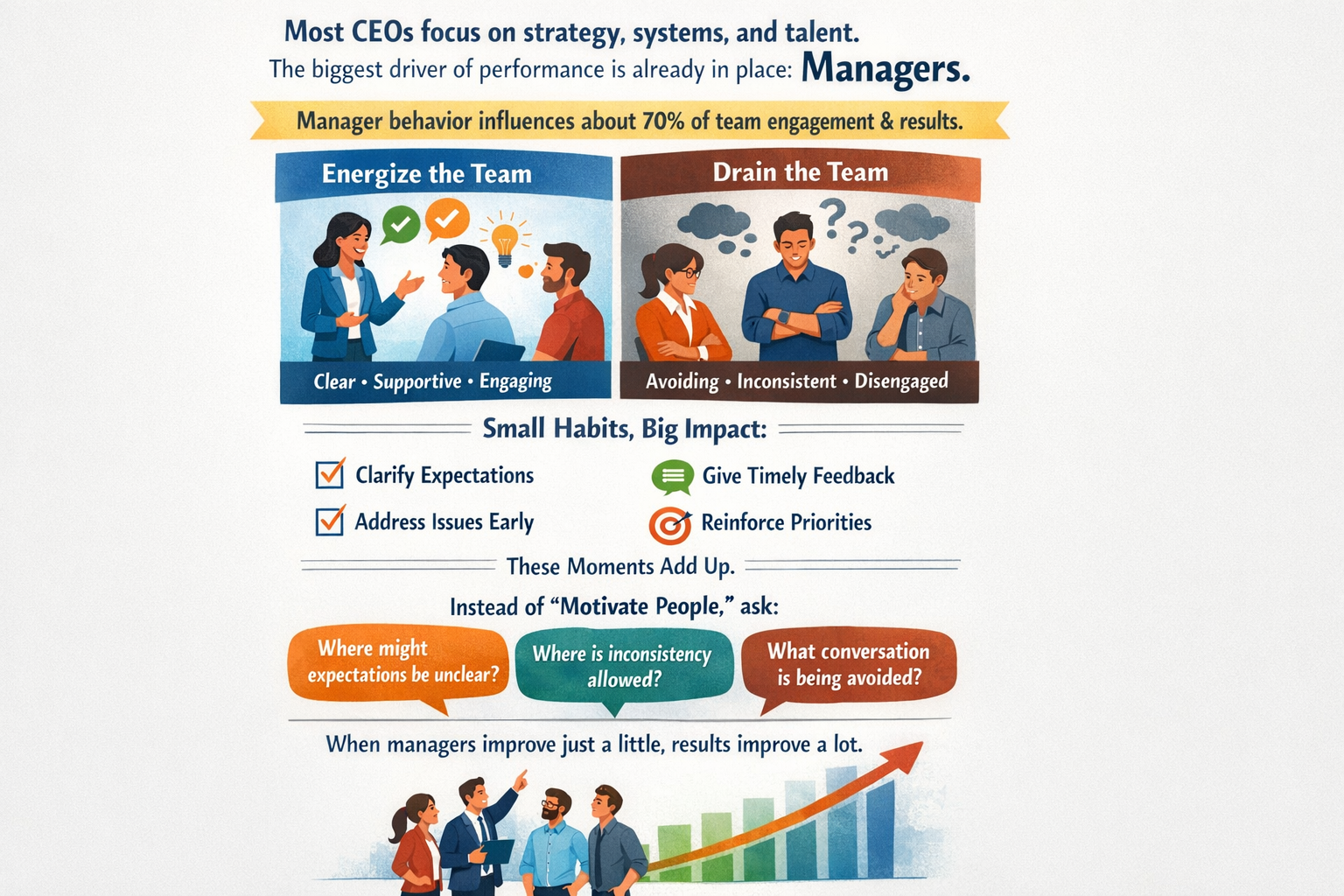
Most CEOs focus on strategy, systems, and talent. But the biggest driver of performance is already in place: managers.
Manager behavior influences about 70% of team engagement and results. What happens in everyday conversations matters more than perks, pay, or policies.
Managers either multiply energy or drain it.
Clear, supportive managers raise performance.
Avoiding, inconsistent managers quietly lower it.
The good news? Small habits make a big difference:
- Clarifying expectations
- Giving timely feedback
- Addressing issues early
- Reinforcing priorities
These moments add up.
Instead of telling managers to “motivate people,” try asking:
- Where might expectations be unclear?
- Where is inconsistency allowed?
- What conversation is being avoided?
When managers improve just a little, results improve a lot.
👉 Join our 60-minute
Leadership Conversation to explore how everyday manager habits quietly shape engagement and results.
Jason left his one-on-one feeling encouraged. His supervisor, Ellen, had listened as he described competing deadlines and his interest in becoming a team leader. They talked about the possibility of shifting some of his workload. Ellen also suggested that training might help him prepare for a leadership role. "Let's work on that," she said. Jason thought help was coming. Ellen thought Jason would bring her a plan. Two weeks later, the deadlines were closer. Nothing had been reassigned. Neither had looked into training. During their next one-on-one, Ellen asked how things were going. "I'm still waiting to hear which project you want me to focus on," Jason said. "I thought we agreed that you would work that out." "And the leadership training?" "Did you find a course?" Jason paused. "I thought you were going to recommend one." They had discussed the same topics. They had left with different expectations. Neither intended to let the other down. But they hadn't agreed on who would do what, or when. Turn a Good Conversation into Clear Next Steps Listening matters. So does what happens after you listen. Before you end your next one-on-one, take a few minutes to make sure you and your employee understand what comes next. Talk about priorities. If everything can't be done at once, agree on what comes first. Ask what might get in the way, and what support would help. Make room for professional growth, too. What does the employee want to learn? What responsibility would they like to prepare for? Identify a step you can each take to move that development forward. Then write down your agreements. Keep the notes simple: what needs to happen, who will do it, and by when. Include your own commitments. Putting It Into Practice Ellen and Jason tried again. "The client proposal comes first," Ellen said. "I'll talk with Marcus today about taking over the weekly report. By Friday, I'll let you know whether he can." "I'll find two leadership courses before our next meeting," Jason said. "Then we can talk about which one fits." Both Jason and Ellen knew what to do next. The following week, both reported their findings and they made decisions on how to move forward. Jason’s work became more aligned with Ellen’s departmental goals. Jason felt valued and appreciated. Their weekly one-to-ones became the backbone of their workplace success. Want to Make Your Workplace Conversations More Productive? Join us for the Workplace Conversations Clinic on October 19 . Bring a conversation you want to handle more effectively, and let's work on making the next steps clear. Register Here
Sally appreciated that her supervisor made time for weekly one-on-ones. It made her feel valued. But after 18 months with Emerald Corp, something was missing. She rarely received feedback. Her supervisor didn’t tell her what she was doing especially well—or where she needed to improve. And although the company had promised continuing education when she was hired, no development opportunities had materialized. Sally loved learning. Several next-level positions interested her, but she knew she needed additional knowledge and skills. Meanwhile, two college classmates working in other departments had already been promoted. She was a fast learner. She was getting bored. And she was beginning to wonder whether she had a future at Emerald. So Sally started applying elsewhere. During Monday’s one-on-one, she asked her supervisor whether he would serve as a reference. He was stunned. “You’re doing well,” he said. “There are lots of opportunities for you here.” Sally asked whether he would support her applying for an internal position. “Well, you’re doing fairly well,” he replied, “but there are several things you could be doing better. You’d also need more experience or training before you’d be ready for the next level.” Sally was confused. “What should I be doing better?” Her supervisor mentioned a few areas for improvement. “Why haven’t you told me this before?” Sally asked. “No news is good news,” he replied. “You’re certainly not at risk of losing your job.” “But you’re telling me I’m not ready for a promotion. How am I supposed to improve if I don’t know what you expect?” Her supervisor assumed Sally would figure it out over time. Sally had assumed she was already meeting expectations. Both assumptions were costly. Within days, Sally had two interviews with other companies. One-on-Ones Should Help Employees Succeed Employees shouldn’t have to guess what high performance looks like. One-on-ones are an opportunity to make expectations clear and help employees become more successful. Talk about what they are doing well. Be specific about where improvement is needed. Ask about their challenges, interests, and future goals. Then provide the coaching, training, and support that can help them succeed. Don’t wait until an employee asks for a reference to talk about their future. Ask before you assume. Conversation is where leadership happens™ Want to Make Your Workplace Conversations More Productive? Join us for the Workplace Conversations Clinic on October 19 . Bring a conversation you want to handle more effectively, and let's work on making the next steps clear. Register HERE
